Scorebook or Scorecard: Two Ways to Keep a Match in View
A cricket scorebook or scorecard answers different questions: learn what each record contains and choose the right one to follow an innings clearly.
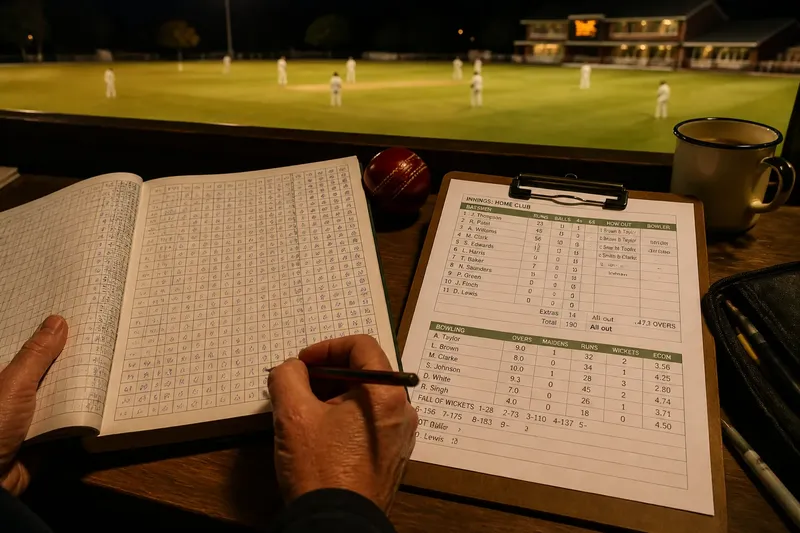
A scorecard shows a cricket innings at a glance; a scorebook lets you follow how each entry built that picture. If you are deciding between a cricket scorebook or scorecard, start with the question you want answered: where does the match stand, or how did it reach this point?
What does each record contain?
A scorecard arranges selected figures into a compact summary. It commonly lists each batter’s runs, balls faced, boundaries and dismissal, alongside the bowlers’ overs, maidens, runs conceded and wickets. Extras and the innings total complete the picture. You can compare contributions quickly, but the figures do not usually show their order.
A scorebook records scoring events as the innings unfolds. In a paper book, a grid and its symbols can mark runs, wickets, extras and other events; digital scoring tools can preserve a similar sequence on screen. A scorebook is therefore useful when you need to trace the events behind a total, rather than simply read the finished figures.
The labels are not entirely consistent. A spectator’s printed card might include a detailed over-by-over record, while an online scorecard may show only a short summary. Check the layout and information provided, not just the name on the page.
How do you read a scorecard without losing the match context?
Begin with the innings heading so you know which side is batting. Then read the total and wickets together: the total shows the runs made, while the wickets show how many batters have been dismissed. Find the batters at the crease and note whether either is marked not out.
Next, consider the bowling figures as a group. Overs indicate how much each bowler has bowled; runs and wickets describe other parts of that bowler’s contribution. A maiden is an over in which no runs are credited to the batting side, though an over can include certain extras and still be a maiden. The scorecard is a snapshot, not a play-by-play account.
Match format supplies further context. In a limited-overs chase, compare the batting side’s position with the target. In a multi-innings match, first establish which innings are complete and which is in progress. The same columns can mean different things depending on the match state.
What can a scorebook tell you that a summary cannot?
The sequence can distinguish a steady innings from one shaped by quiet passages and quick scoring. It can also show whether a wicket followed a period of pressure or came amid a productive partnership. A scorecard may preserve the final contributions, but not necessarily the route between them.
Delivery entries help explain the arithmetic, too. A wide adds to the team total but is not recorded as runs scored by the batter. The scorebook can show where such extras entered the innings; the scorecard gathers them into categories.
Notation varies between scorebooks. One scorer may use abbreviations for extras, while another uses symbols in a printed grid or software interface. Read the key before interpreting unfamiliar marks. Guessing from the shape of a symbol can turn a delivery or dismissal into a misread run.
How can you use both records to trace a moment?
Use the scorecard to establish the position, then consult the scorebook to follow the sequence. Say you arrive at a local match after a wicket. The card shows the team total, wickets lost and the new pair at the crease. In this invented situation, the scorebook then shows that the dismissed batter faced several dot balls before the wicket, followed by a single from the new batter. The summary gives the state of play; the sequence adds context without claiming to explain every decision behind the delivery.
If you are keeping notes, choose the record that suits what you want to remember. A scorecard can serve someone who wants to recall the main contributions. A scorebook suits someone who wants to retrace the order of events. Recording every delivery is not worth the effort if a compact account answers your question.
Which details should you check on a scorecard?
Use these checks to decide what to read next:
- Innings heading: If it names the batting side you expect, compare its figures; if it does not, identify the innings before drawing conclusions.
- Total and wickets: If both are visible, read them together to judge the innings position; if the wickets are missing, avoid treating the total as a full account of the side’s position.
- Not-out marks: If a batter is marked not out, treat that player as still at the crease; if the mark is unclear, check the card’s notation key before deciding whether the innings ended for that batter.
- Extras: If extras appear separately, include them when reconciling the team total; if the total does not seem to add up, look for the extras breakdown rather than assigning them to a batter.
- Bowling figures: If overs, runs and wickets are all listed, read each as a separate part of the contribution; if one column is absent, do not infer it from the others.
- Match state: If the card identifies a chase or completed innings, interpret the total in that context; if it does not, find the match format or innings heading before comparing scores.
Which record should you choose for each question?
For a quick check of the score, current batters or bowling figures, the scorecard is usually easier to scan. It brings selected information together and is convenient to share. For a question about what happened before a wicket, or how extras and runs arrived in sequence, the scorebook is the more useful place to look.
Neither record captures every part of play. A scorebook follows the scorer’s notation, and a scorecard condenses selected events into figures. Neither necessarily describes the fielding positions, the ball’s movement or the reasons behind a delivery. Those details call for a fuller account or the match itself.
What do readers ask about scorebooks and scorecards?
Is a scorecard the same as a scoreboard?
No. A scoreboard displays selected match information, often during play. A scorecard is a fuller summary of an innings or match, whether printed or shown on a screen.
Does a scorebook record every ball?
A detailed scorebook generally records deliveries and scoring events in sequence, but formats differ. Check the scorer’s key to see what its marks include.
Why are extras listed separately?
Extras add to the team total but are not credited as runs to a batter. Listing them separately shows how the total was assembled.
Which record should a beginner read first?
Start with the scorecard’s innings heading, total, wickets and current batters. Turn to the scorebook when you want to understand the order behind a particular event.
How should you handle unfamiliar marks?
There is little benefit in memorising every scoring abbreviation before following a match. Start with the headings and distinguish the summary from the sequence. If a symbol affects your reading, consult the scorebook key or ask the scorer rather than guessing.
For a cricket scorebook or scorecard, the useful choice depends on the question in front of you. Read the scorecard for the match’s outline; use the scorebook when the route to that position matters. Keeping those jobs distinct makes the figures easier to follow and the record easier to interpret.