The Boundary Is Not Always the Same Kind of Line
Understand the cricket boundary line and boundary result, so you can tell how the field edge is marked and why a shot counts as four or six.
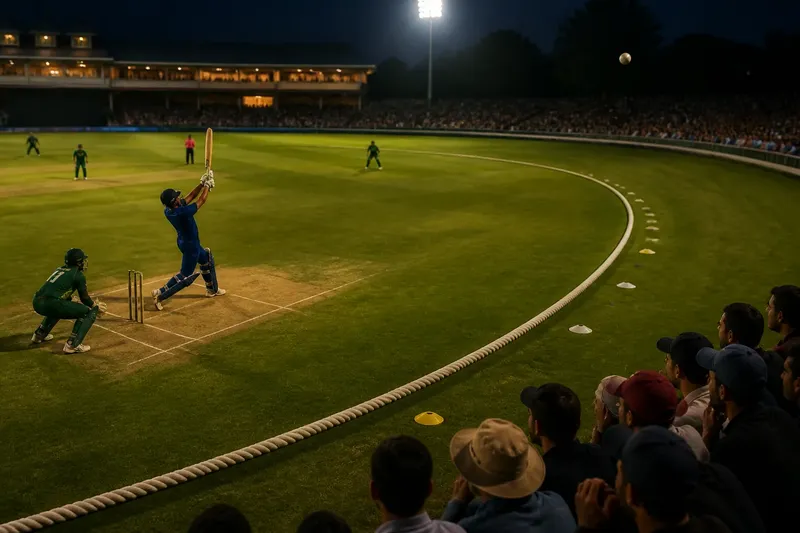
In cricket, the boundary line can be a painted curve, a row of cones or the edge of a rope, while a boundary result is what the umpire awards after the ball reaches or crosses that edge. The distinction matters: the field has a marked perimeter, but the score depends on how the ball gets there and what happens around it.
That is why “the ball reached the boundary” does not always mean the batter receives the same number of runs. To read a decision clearly, separate three things: the boundary marking, the ball’s contact with the ground and the moment it crosses the perimeter.
What does the boundary line mark?
The boundary is the perimeter separating the playing area from the ground beyond it. In many matches, a rope or similar object marks that perimeter. In other settings, the edge may be shown by a painted line or markers. The physical appearance can vary; the job is to identify where the field ends.
The boundary marking is not necessarily a narrow stripe that the ball must strike. It identifies the edge of the playing area. In a rope-marked ground, the rope itself may form part of the boundary. The ball’s relationship to the rope, ground and space beyond it is what matters, rather than whether it lands neatly on a line as it might in a court sport.
For a spectator, the simplest useful question is: did the ball touch the ground inside the boundary before it crossed? If it did, the result is ordinarily a four. If it crossed the boundary without first touching the ground within it, the result is ordinarily a six. Those descriptions assume the ball has not already become dead and that no other playing condition changes the award.
How do the marking and the result differ?
Think of the marking as a reference and the result as a decision. The marking tells players and officials where the perimeter is. The result describes what happens to the score when the ball reaches that perimeter under the circumstances of play.
A ball can touch the rope after bouncing inside the field. The rope marks the edge, but it does not turn that bounce into a six: the first contact with the ground inside the perimeter makes the boundary a four. A ball struck cleanly over the rope without bouncing inside produces a six. In both cases, the ball has crossed the same marked edge; the difference lies in its path before crossing.
There are also boundary decisions that do not fit the simple four-or-six shorthand. A fielder may touch the ball while in contact with the boundary or with ground beyond it. A ball may be stopped near the rope and then carried or deflected over it. Such cases depend on the Laws of Cricket and the match’s playing conditions, so the umpire’s signal and the official score are more reliable than a quick glance from the stands.
Which boundary marking might you see?
Three common approaches help explain why the “line” is not always a literal line. Each gives a visible edge, but the most suitable choice depends on the ground and the match.
Rope or other perimeter object
A boundary rope gives spectators and players a clear physical marker. It suits grounds where a flexible perimeter can be laid out and adjusted for the playing area. The rope is especially easy to spot in a wide view, though a ball close to it may still require officials to judge contact and the fielder’s position.
Painted or drawn boundary line
A marked line can make the perimeter visible without a raised object. It may suit a prepared surface or a setting where a rope is impractical. A viewer should still treat it as the edge of the field, not as a target stripe whose width alone decides the score.
Cones or other discrete markers
Markers can indicate a boundary where a continuous rope or painted curve is unavailable. They suit informal play and temporary layouts, where the players need a shared, visible perimeter. Because gaps can make the exact edge less obvious, the players should agree on how the markers define the boundary before play.
For formal matches, the governing playing conditions determine how the boundary is marked and interpreted. In casual cricket, an agreed boundary is more useful than arguing over whether a ball was “on the line” after the event. If you are unsure about a particular competition, its rules and officials’ guidance settle the matter.
How can you judge a boundary call from the stands?
Follow the ball’s sequence rather than its final position. First locate the boundary marker. Then watch for the ball’s first contact with the ground in relation to that edge. Finally, notice whether a fielder touches the ball near or beyond the perimeter. This order helps explain the decision, though a distant view may not reveal every detail.
Say you are watching an invented match from a seat near the square. A batter hits the ball, which lands inside the rope, rolls onwards and touches it. You can expect the umpire to signal four: the ball touched the ground within the boundary before crossing it. The same shot hit without an intervening bounce inside would be a six if it crossed the boundary on the full.
It is not worth trying to settle a close call by judging the ball’s apparent height or distance from one viewing angle. Perspective can make a ball seem to land beyond the rope when it actually bounced just inside, or hide a fielder’s contact with the marker. Wait for the umpire’s signal, then use a replay or the scorecard if one is available.
What do spectators ask about the cricket boundary line?
Does the ball have to hit the rope?
No. The rope or another marker identifies the perimeter; the ball can cross that edge without striking the marker. The boundary decision depends on the ball’s path and contact with the ground, not on a required collision with a rope.
Why is a ball over the rope sometimes four?
If it first touched the ground inside the boundary, it is ordinarily a four even if it later reaches or passes the rope. A ball that crosses the boundary without bouncing inside is ordinarily a six.
Can a fielder change the boundary result?
Yes. Contact with the boundary or the ground beyond it can affect whether the ball is considered to have reached the boundary, and the playing conditions govern the decision. That is why a catch or stop close to the rope may need careful umpiring.
Is a boundary the same thing as a four?
No. “Boundary” can mean the field’s perimeter, or it can refer informally to a scoring shot that reaches it. A four or six is the result awarded in a particular passage of play, not the marking itself.
Which approach helps you read the game?
If you are learning cricket language, keep the physical edge and the scoring event as separate ideas. Use “boundary” for the perimeter when discussing the field, and “four” or “six” when describing the runs awarded. This avoids the common but misleading claim that every ball over a rope is a six.
If you are setting up informal play, agree on a visible perimeter before the first delivery. A rope suits a large open area; paint may suit a prepared surface; cones can help define a temporary edge. Choose the clearest option for the ground, then make sure everyone understands what counts as beyond it.
For a close decision in a formal match, trust the umpire’s signal and the official record rather than trying to infer the ruling from the word “line”. Once you distinguish the marked edge from the boundary result, the cricket boundary line becomes easier to read: the marker shows where the field ends, while the ball’s route determines what the scorer records.